UMU Launches Decolonisation Pathways, Vol. 2 Book Series
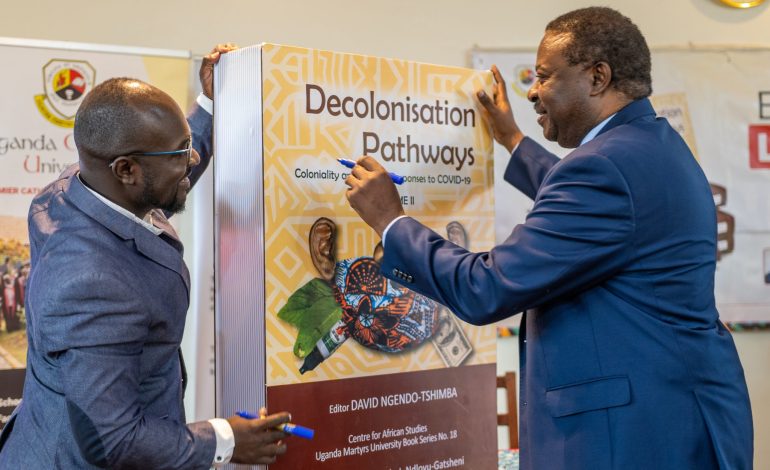
Uganda Martyrs University (UMU) hosted the official launch of Decolonisation Pathways, Vol. 2, a publication that critically examines the intersection of coloniality, science, and Africa’s future.
The Guest of Honor, Prof. Pontiano Kaleebu, a distinguished scientist and director at the Uganda Virus Research Institute, addressed the audience with a thought-provoking question: “How do we move from being recipients of foreign vaccines to leading in research and development?” His statement underscored the urgency of repositioning Africa as a leader in scientific and technological advancement.
 The book launch event emphasized three critical areas of action necessary for Africa’s scientific sovereignty and self-sufficiency:
Government Investment in African Science and Research– To foster scientific independence, governments must prioritize substantial investment in research and development. This includes increasing financial allocations for scientific institutions, establishing cutting-edge laboratories, and supporting collaborations that generate innovative, homegrown solutions. Such investments will not only enhance Africa’s global competitiveness but also reduce reliance on external scientific assistance.
Recognition and Integration of Traditional Medicine in Policy and Practice– The marginalization of indigenous knowledge systems due to colonial legacies has led to the underutilization of traditional medicine. Acknowledging the role of traditional healing practices in Africa’s healthcare system is vital. There is a need for research-driven validation of traditional medicine to ensure its integration into national health policies. This approach will bridge the gap between conventional medical practices and indigenous knowledge, fostering a more inclusive and effective healthcare system.
The book launch event emphasized three critical areas of action necessary for Africa’s scientific sovereignty and self-sufficiency:
Government Investment in African Science and Research– To foster scientific independence, governments must prioritize substantial investment in research and development. This includes increasing financial allocations for scientific institutions, establishing cutting-edge laboratories, and supporting collaborations that generate innovative, homegrown solutions. Such investments will not only enhance Africa’s global competitiveness but also reduce reliance on external scientific assistance.
Recognition and Integration of Traditional Medicine in Policy and Practice– The marginalization of indigenous knowledge systems due to colonial legacies has led to the underutilization of traditional medicine. Acknowledging the role of traditional healing practices in Africa’s healthcare system is vital. There is a need for research-driven validation of traditional medicine to ensure its integration into national health policies. This approach will bridge the gap between conventional medical practices and indigenous knowledge, fostering a more inclusive and effective healthcare system.
 Bridging the Gap Between Academia and Real-World Impact–Academic research must be aligned with real-world challenges to enhance its relevance and applicability. Universities should actively collaborate with industries, policymakers, and local communities to ensure that research contributes meaningfully to societal progress. Strengthening these partnerships will accelerate the translation of academic knowledge into tangible innovations that address pressing issues in Africa.
The Broader Context of Decolonization–The launch also underscored the broader significance of decolonization beyond historical narratives. According to Spire Ssentongo, a renowned Ugandan academic, “Decolonization is not just rewriting history; it’s reclaiming the future.” This perspective highlights the need to dismantle systems of intellectual and economic dependency and advocate for African agency in knowledge production, policy formulation, and economic development.
Bridging the Gap Between Academia and Real-World Impact–Academic research must be aligned with real-world challenges to enhance its relevance and applicability. Universities should actively collaborate with industries, policymakers, and local communities to ensure that research contributes meaningfully to societal progress. Strengthening these partnerships will accelerate the translation of academic knowledge into tangible innovations that address pressing issues in Africa.
The Broader Context of Decolonization–The launch also underscored the broader significance of decolonization beyond historical narratives. According to Spire Ssentongo, a renowned Ugandan academic, “Decolonization is not just rewriting history; it’s reclaiming the future.” This perspective highlights the need to dismantle systems of intellectual and economic dependency and advocate for African agency in knowledge production, policy formulation, and economic development.
 The launch of Decolonisation Pathways, Vol. 2 reaffirmed UMU’s commitment to critical discourse and the advancement of African knowledge systems. The publication serves as both an academic resource and a strategic guide for policymakers, educators, and researchers seeking to redefine Africa’s trajectory in scientific and intellectual fields. As the book is disseminated across institutions and policy circles, it is anticipated that its insights will drive concrete actions toward a decolonized and self-reliant Africa.
The discussions held during the launch event will serve as a foundation for ongoing engagement, policy shifts, and institutional reforms aimed at fostering Africa’s scientific and intellectual independence.
The launch of Decolonisation Pathways, Vol. 2 reaffirmed UMU’s commitment to critical discourse and the advancement of African knowledge systems. The publication serves as both an academic resource and a strategic guide for policymakers, educators, and researchers seeking to redefine Africa’s trajectory in scientific and intellectual fields. As the book is disseminated across institutions and policy circles, it is anticipated that its insights will drive concrete actions toward a decolonized and self-reliant Africa.
The discussions held during the launch event will serve as a foundation for ongoing engagement, policy shifts, and institutional reforms aimed at fostering Africa’s scientific and intellectual independence.
The book launch event emphasized three critical areas of action necessary for Africa’s scientific sovereignty and self-sufficiency:
Government Investment in African Science and Research– To foster scientific independence, governments must prioritize substantial investment in research and development. This includes increasing financial allocations for scientific institutions, establishing cutting-edge laboratories, and supporting collaborations that generate innovative, homegrown solutions. Such investments will not only enhance Africa’s global competitiveness but also reduce reliance on external scientific assistance.
Recognition and Integration of Traditional Medicine in Policy and Practice– The marginalization of indigenous knowledge systems due to colonial legacies has led to the underutilization of traditional medicine. Acknowledging the role of traditional healing practices in Africa’s healthcare system is vital. There is a need for research-driven validation of traditional medicine to ensure its integration into national health policies. This approach will bridge the gap between conventional medical practices and indigenous knowledge, fostering a more inclusive and effective healthcare system.
Bridging the Gap Between Academia and Real-World Impact–Academic research must be aligned with real-world challenges to enhance its relevance and applicability. Universities should actively collaborate with industries, policymakers, and local communities to ensure that research contributes meaningfully to societal progress. Strengthening these partnerships will accelerate the translation of academic knowledge into tangible innovations that address pressing issues in Africa.
The Broader Context of Decolonization–The launch also underscored the broader significance of decolonization beyond historical narratives. According to Spire Ssentongo, a renowned Ugandan academic, “Decolonization is not just rewriting history; it’s reclaiming the future.” This perspective highlights the need to dismantle systems of intellectual and economic dependency and advocate for African agency in knowledge production, policy formulation, and economic development.
The launch of Decolonisation Pathways, Vol. 2 reaffirmed UMU’s commitment to critical discourse and the advancement of African knowledge systems. The publication serves as both an academic resource and a strategic guide for policymakers, educators, and researchers seeking to redefine Africa’s trajectory in scientific and intellectual fields. As the book is disseminated across institutions and policy circles, it is anticipated that its insights will drive concrete actions toward a decolonized and self-reliant Africa.
The discussions held during the launch event will serve as a foundation for ongoing engagement, policy shifts, and institutional reforms aimed at fostering Africa’s scientific and intellectual independence.